How to Turn Abandoned Carts into Sales: Understanding the Psychology Behind Cart Abandonment
Abandoned carts can be frustrating, but understanding the reasons behind them can help turn those missed opportunities into sales. In this post, we’ll delve into the psychology behind cart abandonment and provide actionable tips to convert those abandoned carts into revenue.
Differences
Abandoned Carts and Abandoned Checkouts often get lumped into the same group.
But there are a couple key differences between the two and those differences make having BOTH of these flows active even more important.
Starting with the basics…
If someone visits your website, looks at a few products and then bounces, (leaves the site) a browse abandonment flow should be triggered.
If someone visits your website, looks at a few products, adds something to their cart, and then bounces, a cart abandonment flow should be triggered.
If someone visits your website, looks at a few products, adds something to their cart, starts the checkout process, and then bounces, an abandoned checkout flow should be triggered.
Each of these flows is similar, but the key difference is the level of buyer intent.
So to maximize your revenue, you’re going to want flows that are targeted towards each level.
With that in mind. Let’s talk about the psychology behind the different flows.
Psychology
Carts are abandoned for all sorts of different reasons. Checkouts are abandoned for different reasons.
The most basic reason, that applies to both, is that something happened and the customer just forgot to complete their purchase.
But when you get past that reason, there are some subtle differences between adding to cart and starting checkout.
Let’s start by looking at why someone might add to cart, and then not click to checkout.
- Comparison shopping
- Price
- Is it the right solution for me?
- Do I need it?
- Change of mind
- Too many options
Someone who adds to cart, but doesn’t click to checkout is probably in the “Solution Aware” stage of their journey.
They know that they have a problem and they are aware of the different solutions, but they aren’t sure that your product is the right one for them.
You’re going to want to provide proof to these customers that your product or service can solve the problem that they have.
You can do this through emails with customer testimonials, emails that handle objections, or (one of my favorites) emails that tell the founder’s story and why/how they developed the product to solve a problem that they were facing.
And then what are the reasons that someone might click to checkout, but not complete purchase
- Total price
- Shipping
- Security concerns
- Confusing checkout page
These customers are closer to the “Product Aware” stage of their journey and they may even be in the “Most Aware” stage.
Emails that address any last minute objections, FAQs, or future pacing emails work great here. You can also use FOMO, scarcity, and urgency. (Just don’t fabricate scarcity if there isn’t any.)
This is also a great place to use a special discount code to give your prospect that last little push. A percentage off or free shipping tends to work really well.
Framework
Alright, let’s get into the nitty gritty of Abandoned Carts and Abandoned Checkouts.
No matter what ESP (email service provider, Klaviyo, ActiveCampaign, MailChimp, etc.) you’re using, you can set up these flows. There might be minor differences in the how, but today I’m going to focus on how to set these up in Klaviyo.
And this is only going to be a high level overview. If you’re looking for in-depth steps, check out Klaviyo’s help articles.
For both of these flows, Klaviyo has pre-built templates to get you started. You will need to have your code snippet installed on your website to track page views in order to get the cart abandoned flow to trigger correctly.
The trigger for Abandoned Cart will be “added to cart” and there will be a flow filter in place to remove anyone who starts a checkout.
The trigger for Abandoned Checkout will be “checkout started” and there will be a flow filter in place to remove anyone who places an order (or completes purchase.)
I also add two additional filters for each flow.
- Remove anyone who has been in the flow within the last 30 days
- Remove anyone who has joined the list in the last 10-14 days (depending on the length of your welcome flow)
The cadence that I’ll use for both flows is essentially the same.
- Email #1: 2-4 hours after trigger
- Email #2: 24 hours after trigger
- Email #3: 48 hours after trigger
The cadence isn’t what makes or breaks the flow. I’ve set up some with 4 emails and some with only two. You can shorten the time frame and send 3 emails within 24 hours or you could send 3 emails over three days.
Ultimately, you should test to see what resonates the most with your audience.
For the abandoned checkout, I typically don’t offer any incentive until email #3. And I also only offer that incentive to first time buyers with a dynamic Klaviyo code so that it expires after 24-48 hours.
Case Studies – Abandoned Checkout
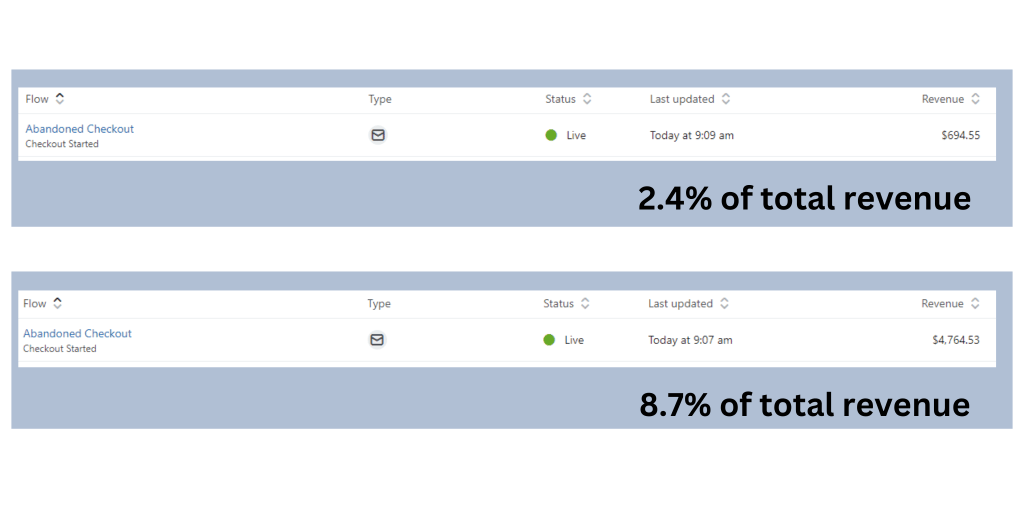
To wrap this up, we are going to take a quick look at two client examples. These are both current clients so I can only share some limited information about both accounts.
In both cases, there was no abandoned checkout in place.
The first client is in the supplement niche. AOV is $54.46. This flow has generated between $500 and $1000 per month for the past 6 months.
I used 4 emails for this flow. Three in the first 24 hours and then a 4th after 2 days.
- Email #1 – Reminder of abandoned checkout
- Email #2 – Scarcity (product tends to sell-out)
- Email #3 – Customer reviews
- Email #4 – Final call
No surprise but the first email and the last email have the highest click rates and account for a majority of the revenue.
The second client is in the sportswear and apparel niche. Their AOV is $47.64. This company had zero email marketing flows in place when I took over.
The first flow that we implemented was this Abandoned Checkout flow. In the first 30 days it generated almost $5K.
Full disclosure: there was one really large order that was attributed to the abandoned checkout flow. Even without that order the abandoned checkout flow accounted for 5% of the total revenue for April.
I used four emails for this flow. Two in the first 24 hours and then the final email (split based on first time purchasers) a day later.
- Email #1 – Reminder
- Email #2 – FOMO
- Email #3 (first time purchaser) – Final call with discount
- Email #3 (repeat customer) – Final call before cart is reset
Summary
Thanks for reading. Hope you got something today that you can take away and implement immediately.
In case you skimmed down to this section…
Differences:
- Added to cart v Started checkout
- Higher level of buyer awareness for abandoned checkout
Psychology:
- Cart Abandoned – Most likely “solution aware” to “product aware”
- Need more information
- Abandoned Checkout – Most likely “product aware” to “most aware”
- Need that final push
Trigger:
- Different triggers in Klaviyo – use templates to start
- Add filters to remove:
- Anyone who’s been in the flow recently
- Anyone who’s new to the list
What Should YOU Do Next?
- Follow me on LinkedIn for daily email tips and what’s working now
- Leave a like or a comment on this post to let me know what you thought.
- If you need an email list manager for your brand or business, send me an email at ben@henkenmarketing.com or fill out this form and I’ll be in touch.
- Sign up for my weekly newsletters here and get these email tips and tricks sent directly to your inbox.
 Email Marketing Solutions
Leave a comment